
The Countdown Clock Shrinks: How New Quantum Papers Compressed the Threat to Digital Security

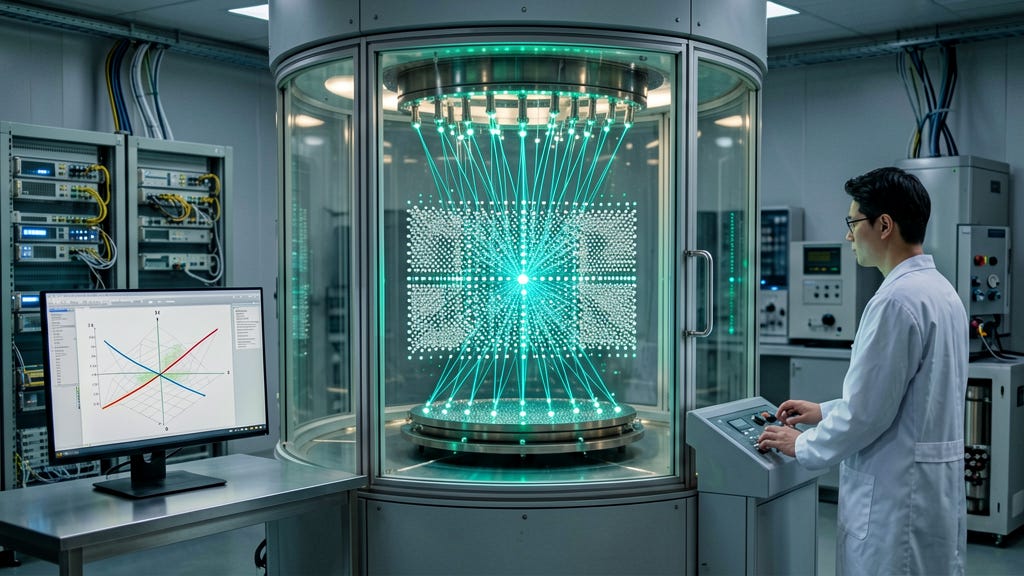
For decades, the bedrock of modern digital life—from securing online banking to validating blockchain transactions—has rested upon the strength of Elliptic-Curve Cryptography (ECC). This mathematics, elegantly complex, provides a nearly unbreakable digital lock, making today’s encrypted conversations and stored assets safe from brute-force attacks. However, the looming development of sufficiently powerful quantum computers poses an existential threat to this foundation. The question of when that threat materializes—the point often termed Q-day—has become a subject of intense, sometimes speculative, debate. Now, a flurry of significant scientific papers released in March and June of 2026 have acted like a sudden, decisive tightening of the screws, materially shrinking the public estimate for when cryptographically relevant quantum attacks on ECC could become a reality.
The Accelerating Pace of Quantum Cryptanalysis
The impact of these recent publications lies not in a single, dramatic announcement, but in a convergence of highly sophisticated, independently verified technical advances. In a single, concentrated period in March 2026, research published from Google Quantum AI and the Oratomic team simultaneously presented resource estimates that drastically lowered the barrier to entry for quantum adversaries. These findings provided concrete, measurable data points on the computational power required to crack current ECC standards, signaling a palpable shift in the risk assessment for global digital infrastructure.
These technical insights were swiftly followed by complementary work. In June 2026, André Schrottenloher independently validated and refined some of the algorithmic optimizations previously disclosed by Google. This was quickly followed by commentary from Craig Gidney, who reflected on the delicate process of scientific disclosure in the face of such critical cryptographic risks. The cumulative effect of these papers is a clearer, more urgent picture of the migration timeline required to secure our data against the advent of large-scale quantum computation.
Deep Dive into Google’s Resource Estimates and Responsible Disclosure
One of the most influential contributions came from the paper, “Securing Elliptic Curve Cryptocurrencies against Quantum Vulnerabilities: Resource Estimates and Mitigations,” authored by Ryan Babbush, Adam Zalcman, Craig Gidney, Michael Broughton, Tanuj Khattar, Hartmut Neven, Thiago Bergamaschi, Justin Drake, and Dan Boneh, published on arXiv on March 30, 2026. This research tackled the core question: how many qubits and how much computation is needed to execute Shor’s algorithm against established curves like secp256k1—the curve underpinning Bitcoin and Ethereum?
The authors provided two compelling metrics for the required computational power. On one hand, when measuring the raw physical hardware, the estimates showed a reduction of nearly 20 times compared to earlier projections. On the other hand, when measuring the theoretical efficiency in terms of logical spacetime volume (a measure of total computation required), they demonstrated a roughly order-of-magnitude improvement, or about a 10-fold reduction over the most efficient prior methods. Specifically, to break secp256k1, their model requires either less than 1,200 logical qubits coupled with fewer than 90 million Toffoli gates, or alternatively, less than 1,450 logical qubits alongside fewer than 70 million Toffoli gates, depending on the specific qubit-to-gate tradeoff chosen.

Comparison of Quantum Resource Estimates for Breaking ECC. This diagram contrasts the theoretical resource reduction reported by Google (logical measures) versus the hardware-centric qubit requirements reported by Oratomic.
Crucially, this paper introduced a highly debated method of communication. In the interest of what the authors termed “responsible disclosure,” the team deliberately withheld the underlying, optimized quantum circuits. Instead, they substantiated their findings by publishing a zero-knowledge proof (ZKP). This cryptographic tool allowed external parties to verify the authors’ claims about the complexity of the attack without revealing the sensitive, actionable attack vectors themselves.
The Atomic Leap: Oratomic and the 10,000 Qubit Floor
Simultaneously, on March 30, 2026, the Oratomic team—comprising Madelyn Cain, Qian Xu, Robbie King, Lewis R. B. Picard, Harry Levine, Manuel Endres, John Preskill, Hsin-Yuan Huang, and Dolev Bluvstein—published their findings in “Shor’s algorithm is possible with as few as 10,000 reconfigurable atomic qubits.” This work provided a startlingly different, hardware-centric perspective.
Where prior estimates suggested that breaking ECC would necessitate systems requiring millions of physical qubits, the Oratomic paper asserted that Shor’s algorithm could be executed at cryptographically relevant scales using as few as 10,000 reconfigurable atomic qubits. For the specific P-256 elliptic curve, the abstract noted that the runtime for discrete logarithms could potentially be just a few days using a system featuring 26,000 physical qubits, positioning 10K as the foundational minimum. It is important to note that while the Oratomic paper benchmarks P-256, both P-256 and secp256k1 are 256-bit prime-field curves, suggesting the performance transferability is high. This represented a direct and powerful two-order-of-magnitude reduction in the physical qubit requirements previously cited by the community. This research coincided with Google Quantum AI’s own announcement in March 2026 of expanding into neutral-atom quantum computing at its Boulder lab, a move framed as pursuing a “dual modality” strategy alongside their ongoing superconducting qubit efforts.
Independent Validation and the Debate Over Openness
The technical narrative gained further momentum in June 2026 with the publication of André Schrottenloher’s paper, “Optimized Point Addition Circuits for Elliptic Curve Discrete Logarithms.” Schrottenloher, working from the Centre Inria de l’Université de Rennes in France, independently derived optimized circuit constructions for the Elliptic Curve Discrete Logarithm Problem. His work achieved results comparable to, and in some metrics slightly exceeding, the circuit efficiencies hidden within the Google paper. Schrottenloher explicitly pointed out that the Babbush et al. group had chosen not to reveal their logical quantum circuits, relying instead on the ZK proof.
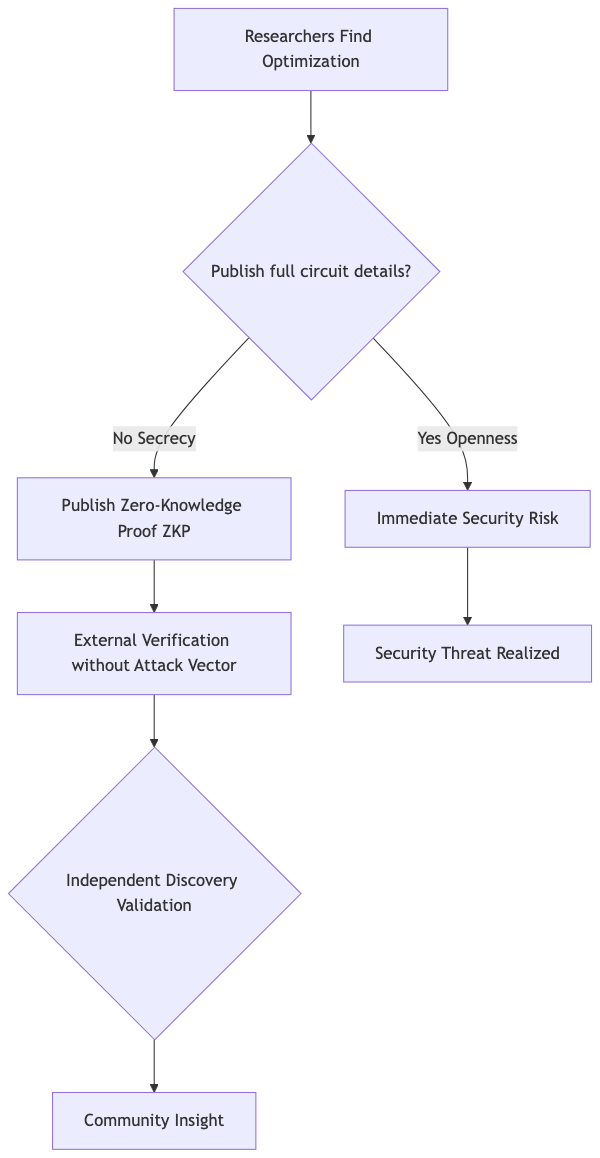
The Scientific Disclosure Trade-Off. This flow illustrates the tension between revealing sensitive attack vectors and providing verifiable proof of complexity in quantum research.
This independent discovery brought into sharp focus the policy implications surrounding scientific transparency. Craig Gidney, having previously detailed a method to make such attacks cheaper, shared his reflections on his blog, titled “The French have the Quantum Circuits.” In his post, Gidney recalled his own team’s initial efforts and the subsequent “pushback on the wisdom of publishing.” After a compromise led to the publication of ZKPs, Schrottenloher’s subsequent work demonstrated that the optimization had been rediscovered independently. Gidney concluded this reflection by stating, “We should just publish openly,” highlighting a significant philosophical debate within the quantum security community regarding the balance between security through secrecy and security through transparent scrutiny.
Reshaping the Migration Road Map
The scientific tightening of these timelines directly impacts the real-world timelines for upgrading global cybersecurity infrastructure—a concept known as preparing for Q-day. To put it simply, the faster the theoretical threat arrives, the sooner industries must complete their massive, costly cryptographic migrations.
Industry leaders have begun aligning their strategic timelines based on these accelerated insights. Google, Cloudflare, and the Ethereum Foundation have all signaled aggressive targets, with many organizations aiming for completion around 2029. The United States federal government has established a more stringent, longer-term mandate derived from documents like NSM-10, setting the ultimate target for full quantum resistance of all National Security Systems by 2035, with intermediate compliance milestones set for 2027 and 2031 under CNSA 2.0.
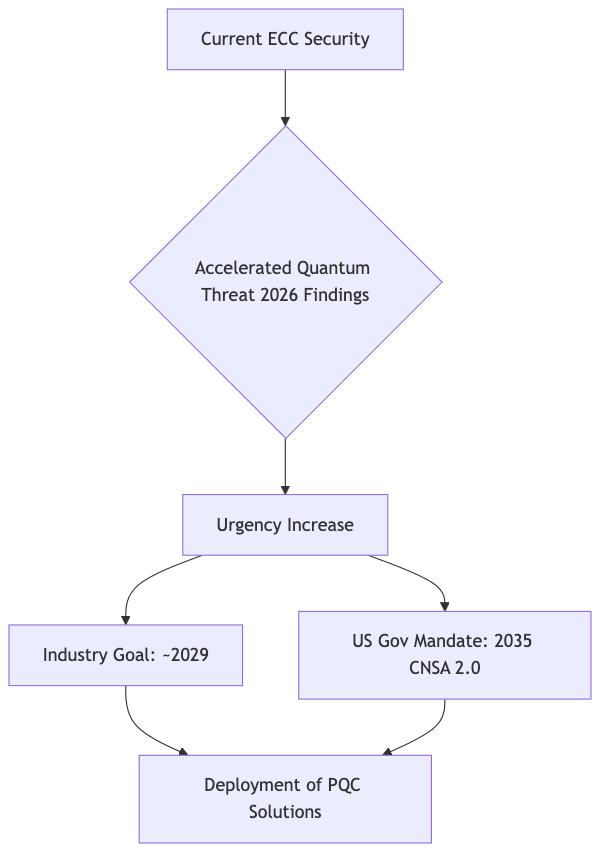
Impact of Accelerated Threat on Migration Timeline. This timeline shows how the accelerated quantum threat forces organizations to move their security migration goals forward.
Commentary from trusted researchers also reflects this urgency. Scott Aaronson, in a post from April 2026, cited the growing consensus among reputable quantum experts that a fault-tolerant computer capable of breaking deployed cryptosystems could be achievable around 2029. Justin Drake, a co-author of the initial Google paper and researcher at the Ethereum Foundation, has personally forecast specific probabilities for Q-day, including a 10% chance by 2030 and a 50% chance by 2032. Furthermore, established projects, such as the Ethereum Foundation’s “lean-Ethereum” roadmap, actively seek to replace vulnerable cryptographic primitives like ECDSA with hash-based cryptography in their next-generation protocol stacks.
Beyond the Threat: Incentivizing Quantum Security
The field is not only reacting to threats but is actively investing in solutions. The Ethereum Foundation, for example, has initiated the Proximity Prize, a program offering $1 million across two grand challenges focused on specific problems in coding theory. These theoretical advancements are vital because they improve the construction of efficient, post-quantum zero-knowledge proofs, which are themselves foundational to many next-generation cryptographic systems. Additionally, the larger Poseidon Initiative operates as a portfolio, with its largest single prize—a $992,000 award for a specific Poseidon1 collision—set for 2029, demonstrating a commitment to bounty-driven cryptographic breakthroughs.
A New Era of Calculation
What these March and June 2026 publications collectively demonstrate is a maturation of the quantum threat landscape. The technical estimate for the required resources to break ECC has seen tangible, large-scale reduction by orders of magnitude. Simultaneously, the institutional discourse around how to safely share this knowledge—the tightrope walk between security through obscurity and security through peer review—is being actively negotiated.
It must be emphasized that all reported resource estimates are purely theoretical projections; no quantum computer has yet successfully executed Shor’s algorithm on a production-level system. Moreover, the Oratomic claim relies on the successful realization of specific hardware properties within neutral-atom technology at scale. The migration target dates, while highly informative for policymakers, remain strategic choices made under conditions of deep uncertainty. Yet, the honest framing remains: the expert consensus on the required technical hurdles has definitively tightened. This ongoing scientific race sets the clock ticking for every organization relying on today’s digital trust, pushing the world toward a quantum-resistant future.
This blog post is based on this research article.
If you liked this blog post, I recommend having a look at our free deep learning resources or my YouTube Channel.
Text and images of this article are licensed under Creative Commons License 4.0 Attribution. Feel free to reuse and share any part of this work. AI was used to support the creation of this article.
ver, the looming development of sufficiently powerful quantum computers poses an existential threat to this foundation. The question of when that threat materializes—the point often termed Q-day—has become a subject of intense, sometimes speculative, debate. Now, a flurry of significant scientific papers released in March and June of 2026 have acted like a sudden, decisive tightening of the screws, materially shrinking the public estimate for when cryptographically relevant quantum attacks on ECC could become a reality.
The Accelerating Pace of Quantum Cryptanalysis
The impact of these recent publications lies not in a single, dramatic announcement, but in a convergence of highly sophisticated, independently verified technical advances. In a single, concentrated period in March 2026, research published from Google Quantum AI and the Oratomic team simultaneously presented resource estimates that drastically lowered the barrier to entry for quantum adversaries. These findings provided concrete, measurable data points on the computational power required to crack current ECC standards, signaling a palpable shift in the risk assessment for global digital infrastructure.
These technical insights were swiftly followed by complementary work. In June 2026, André Schrottenloher independently validated and refined some of the algorithmic optimizations previously disclosed by Google. This was quickly followed by commentary from Craig Gidney, who reflected on the delicate process of scientific disclosure in the face of such critical cryptographic risks. The cumulative effect of these papers is a clearer, more urgent picture of the migration timeline required to secure our data against the advent of large-scale quantum computation.
Deep Dive into Google’s Resource Estimates and Responsible Disclosure
One of the most influential contributions came from the paper, “Securing Elliptic Curve Cryptocurrencies against Quantum Vulnerabilities: Resource Estimates and Mitigations,” authored by Ryan Babbush, Adam Zalcman, Craig Gidney, Michael Broughton, Tanuj Khattar, Hartmut Neven, Thiago Bergamaschi, Justin Drake, and Dan Boneh, published on arXiv on March 30, 2026. This research tackled the core question: how many qubits and how much computation is needed to execute Shor’s algorithm against established curves like secp256k1—the curve underpinning Bitcoin and Ethereum?
The authors provided two compelling metrics for the required computational power. On one hand, when measuring the raw physical hardware, the estimates showed a reduction of nearly 20 times compared to earlier projections. On the other hand, when measuring the theoretical efficiency in terms of logical spacetime volume (a measure of total computation required), they demonstrated a roughly order-of-magnitude improvement, or about a 10-fold reduction over the most efficient prior methods. Specifically, to break secp256k1, their model requires either less than 1,200 logical qubits coupled with fewer than 90 million Toffoli gates, or alternatively, less than 1,450 logical qubits alongside fewer than 70 million Toffoli gates, depending on the specific qubit-to-gate tradeoff chosen.
Comparison of Quantum Resource Estimates for Breaking ECC. This diagram contrasts the theoretical resource reduction reported by Google (logical measures) versus the hardware-centric qubit requirements reported by Oratomic.
Crucially, this paper introduced a highly debated method of communication. In the interest of what the authors termed “responsible disclosure,” the team deliberately withheld the underlying, optimized quantum circuits. Instead, they substantiated their findings by publishing a zero-knowledge proof (ZKP). This cryptographic tool allowed external parties to verify the authors’ claims about the complexity of the attack without revealing the sensitive, actionable attack vectors themselves.
The Atomic Leap: Oratomic and the 10,000 Qubit Floor
Simultaneously, on March 30, 2026, the Oratomic team—comprising Madelyn Cain, Qian Xu, Robbie King, Lewis R. B. Picard, Harry Levine, Manuel Endres, John Preskill, Hsin-Yuan Huang, and Dolev Bluvstein—published their findings in “Shor’s algorithm is possible with as few as 10,000 reconfigurable atomic qubits.” This work provided a startlingly different, hardware-centric perspective.
Where prior estimates suggested that breaking ECC would necessitate systems requiring millions of physical qubits, the Oratomic paper asserted that Shor’s algorithm could be executed at cryptographically relevant scales using as few as 10,000 reconfigurable atomic qubits. For the specific P-256 elliptic curve, the abstract noted that the runtime for discrete logarithms could potentially be just a few days using a system featuring 26,000 physical qubits, positioning 10K as the foundational minimum. It is important to note that while the Oratomic paper benchmarks P-256, both P-256 and secp256k1 are 256-bit prime-field curves, suggesting the performance transferability is high. This represented a direct and powerful two-order-of-magnitude reduction in the physical qubit requirements previously cited by the community. This research coincided with Google Quantum AI’s own announcement in March 2026 of expanding into neutral-atom quantum computing at its Boulder lab, a move framed as pursuing a “dual modality” strategy alongside their ongoing superconducting qubit efforts.
Independent Validation and the Debate Over Openness
The technical narrative gained further momentum in June 2026 with the publication of André Schrottenloher’s paper, “Optimized Point Addition Circuits for Elliptic Curve Discrete Logarithms.” Schrottenloher, working from the Centre Inria de l’Université de Rennes in France, independently derived optimized circuit constructions for the Elliptic Curve Discrete Logarithm Problem. His work achieved results comparable to, and in some metrics slightly exceeding, the circuit efficiencies hidden within the Google paper. Schrottenloher explicitly pointed out that the Babbush et al. group had chosen not to reveal their logical quantum circuits, relying instead on the ZK proof.
The Scientific Disclosure Trade-Off. This flow illustrates the tension between revealing sensitive attack vectors and providing verifiable proof of complexity in quantum research.
This independent discovery brought into sharp focus the policy implications surrounding scientific transparency. Craig Gidney, having previously detailed a method to make such attacks cheaper, shared his reflections on his blog, titled “The French have the Quantum Circuits.” In his post, Gidney recalled his own team’s initial efforts and the subsequent “pushback on the wisdom of publishing.” After a compromise led to the publication of ZKPs, Schrottenloher’s subsequent work demonstrated that the optimization had been rediscovered independently. Gidney concluded this reflection by stating, “We should just publish openly,” highlighting a significant philosophical debate within the quantum security community regarding the balance between security through secrecy and security through transparent scrutiny.
Reshaping the Migration Road Map
The scientific tightening of these timelines directly impacts the real-world timelines for upgrading global cybersecurity infrastructure—a concept known as preparing for Q-day. To put it simply, the faster the theoretical threat arrives, the sooner industries must complete their massive, costly cryptographic migrations.
Industry leaders have begun aligning their strategic timelines based on these accelerated insights. Google, Cloudflare, and the Ethereum Foundation have all signaled aggressive targets, with many organizations aiming for completion around 2029. The United States federal government has established a more stringent, longer-term mandate derived from documents like NSM-10, setting the ultimate target for full quantum resistance of all National Security Systems by 2035, with intermediate compliance milestones set for 2027 and 2031 under CNSA 2.0.
Impact of Accelerated Threat on Migration Timeline. This timeline shows how the accelerated quantum threat forces organizations to move their security migration goals forward.
Commentary from trusted researchers also reflects this urgency. Scott Aaronson, in a post from April 2026, cited the growing consensus among reputable quantum experts that a fault-tolerant computer capable of breaking deployed cryptosystems could be achievable around 2029. Justin Drake, a co-author of the initial Google paper and researcher at the Ethereum Foundation, has personally forecast specific probabilities for Q-day, including a 10% chance by 2030 and a 50% chance by 2032. Furthermore, established projects, such as the Ethereum Foundation’s “lean-Ethereum” roadmap, actively seek to replace vulnerable cryptographic primitives like ECDSA with hash-based cryptography in their next-generation protocol stacks.
Beyond the Threat: Incentivizing Quantum Security
The field is not only reacting to threats but is actively investing in solutions. The Ethereum Foundation, for example, has initiated the Proximity Prize, a program offering $1 million across two grand challenges focused on specific problems in coding theory. These theoretical advancements are vital because they improve the construction of efficient, post-quantum zero-knowledge proofs, which are themselves foundational to many next-generation cryptographic systems. Additionally, the larger Poseidon Initiative operates as a portfolio, with its largest single prize—a $992,000 award for a specific Poseidon1 collision—set for 2029, demonstrating a commitment to bounty-driven cryptographic breakthroughs.
A New Era of Calculation
What these March and June 2026 publications collectively demonstrate is a maturation of the quantum threat landscape. The technical estimate for the required resources to break ECC has seen tangible, large-scale reduction by orders of magnitude. Simultaneously, the institutional discourse around how to safely share this knowledge—the tightrope walk between security through obscurity and security through peer review—is being actively negotiated.
It must be emphasized that all reported resource estimates are purely theoretical projections; no quantum computer has yet successfully executed Shor’s algorithm on a production-level system. Moreover, the Oratomic claim relies on the successful realization of specific hardware properties within neutral-atom technology at scale. The migration target dates, while highly informative for policymakers, remain strategic choices made under conditions of deep uncertainty. Yet, the honest framing remains: the expert consensus on the required technical hurdles has definitively tightened. This ongoing scientific race sets the clock ticking for every organization relying on today’s digital trust, pushing the world toward a quantum-resistant future.
This blog post is based on this research article.
If you liked this blog post, I recommend having a look at our free deep learning resources or my YouTube Channel.
Text and images of this article are licensed under Creative Commons License 4.0 Attribution. Feel free to reuse and share any part of this work. AI was used to support the creation of this article.