
The Brain Code Keeps Shifting: Are Our Mental Maps Always Moving?

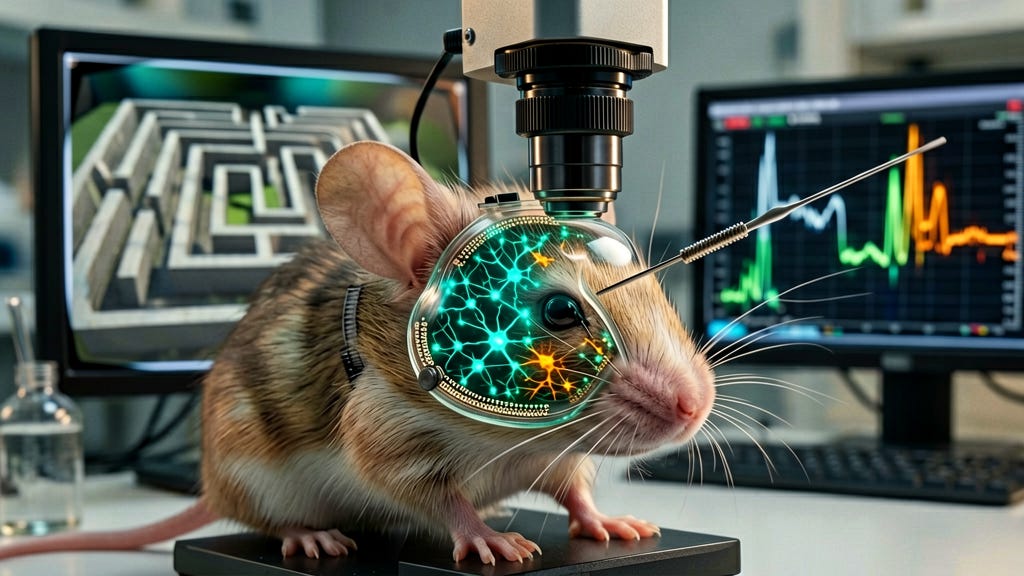
For decades, the foundational stories of neuroscience have rested on a seemingly unshakable pillar: the stability of the neural code. Imagine the brain as an incredibly complex, high-resolution map of the world—a map where specific locations, specific sounds, or specific movements are consistently represented by dedicated, reliable groups of brain cells. This concept, rooted in the revolutionary work of figures like David Hubel and Torsten Wiesel, dictates that a particular neuron, when shown a vertical bar, will fire strongly in response to a vertical bar, month after month. This predictability is not just a detail; it is the cornerstone upon which most of our theories of memory, perception, and learned behavior are built. If the map is stable, the experience is reliable.
But what if the map isn’t a fixed blueprint?
A major synthesis published in Nature in 2026, reflecting a decade of converging evidence, is forcing the scientific community to confront a profound and baffling reality: the brain’s coding language appears to be in constant, subtle motion. This isn’t a minor glitch; it is a fundamental shift in how we understand neurological architecture. This collective body of work—rather than a single, discrete finding—has moved the phenomenon of ‘representational drift’ from the realm of an intriguing experimental anomaly to a central, perplexing puzzle in modern neuroscience.
From Dogma to Drift: The Unexpected Shifting Sands of Neuronal Response
To grasp the magnitude of this shift, one must first understand what we mean by neural tuning. A “tuned” neuron is one that specializes—it consistently responds to a specific stimulus. For example, a visual cortex neuron might be tuned to detect an edge at a precise angle. Textbook neuroscience assumed this tuning was permanent. When scientists began tracking these cells over longer timescales, the assumptions buckled under observational pressure.
The seeds of this revolution were sown years ago by researchers like Laura Driscoll. Beginning her doctoral studies in 2012 at Harvard University, Driscoll set out to confirm the expected stability in mouse parietal cortex. Instead, she encountered the unexpected: over the span of weeks, the specialized responses of many neurons began to wander. Neurons that robustly fired when a mouse occupied a specific corner in a virtual maze on day one had noticeably changed their firing patterns by day thirty. In short, the individual neurons were changing their assigned roles. While the overall pattern of activity across a group of cells might have remained relatively consistent, the identity of the individual cell driving that pattern was fluid. This finding, reported in 2017, directly contradicted established dogma.
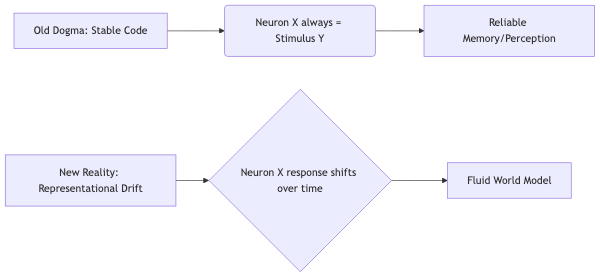
The Shift from Static to Dynamic Neural Coding. Illustrates the contrast between the old view of stable, dedicated neural representations and the new reality of representational drift.
Initially, the scientific response was one of intense skepticism. Many colleagues questioned whether the drift was an experimental artifact—perhaps due to drifting electrodes or subtle, unmeasured behavioral changes in the animals. However, over the ensuing decade, this initial anomaly began to multiply. The same pattern of shifting neural representations was independently reported by multiple groups across vastly different brain areas. Carl Schoonover demonstrated this drift in the olfactory cortex, a region dedicated to scent processing, while other teams confirmed it in the motor cortex and the hippocampus. Today, the community has largely accepted that this drift is a genuine phenomenon, shifting the critical question from “Is it real?” to “What is it doing?”
Three Competing Theories on the Brain’s Dynamic Nature
The observation of drift—that the brain’s representation of the world is not static—has spawned three compelling, yet fiercely debated, theoretical explanations. These hypotheses attempt to account for how the brain can appear stable to us while its underlying wiring is in flux.
The first framework is the “noise” view. This perspective suggests that the changes we observe are simply biological noise—the natural metabolic and structural fidgeting of a living system. From this viewpoint, the brain’s true “code” isn’t held by any single, specialized neuron, but rather by the collective, emergent pattern generated by the entire population of cells. The population acts as a robust averaging filter, absorbing the jitter of its components.
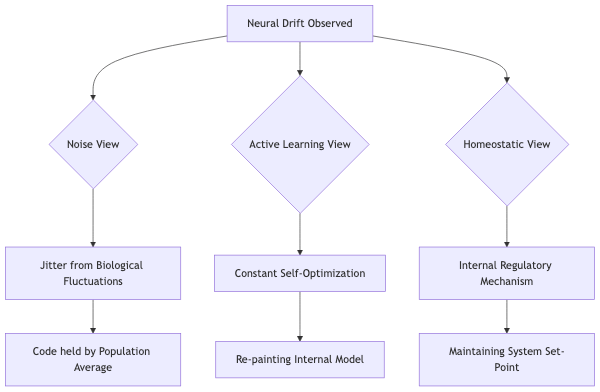
Competing Hypotheses for Neural Drift. Compares the three main theoretical explanations—noise, learning, and homeostasis—for observed representational drift.
A second, more dynamic interpretation frames drift as an active process of “ongoing learning.” In this scenario, the brain is not just recording the world; it is constantly optimizing itself. The constant reallocation of representational capacity allows the brain to effectively “re-paint” its internal world model, freeing up neural real estate to accommodate entirely novel information and experiences.
The third hypothesis centers on a “homeostatic” function. This view posits that the drift is not random or purely adaptive, but is actually the visible byproduct of an internal regulatory mechanism. The network might be self-regulating to maintain a specific, healthy level of overall activity—a biological “set-point.” In this model, the shifting assignments of individual neurons are the visible signature of the system working hard to maintain its equilibrium.
Implications for Technology, Memory, and Health
The implications of understanding representational drift are staggering, reaching far beyond abstract theoretical neuroscience. If the brain’s wiring is malleable, this impacts virtually every cognitive function we study.
One profound impact is on our computational models. Most of the existing mathematical models we use to simulate memory and perception assume a stable single-neuron code. The evidence of drift doesn’t automatically destroy those models, but it forces them to confront a critical gap: how can a model account for representations that are, by nature, temporary?
Furthermore, this has immediate, practical consequences for emerging technologies. Brain-Machine Interfaces (BMIs), which aim to translate the electrical activity of neurons into commands for external devices, rely on decoding intent. If a neuron’s code for “move left” drifts over the course of a few hours, the decoding algorithm must recalibrate constantly. Drift is not just a concept; it is a live technical hurdle in building robust neural prosthetics.
Finally, drift provides a potential lens through which to view pathology. If a certain rate of drift is normal for healthy learning and adaptation, then an absence of drift might signal a pathology—a system stuck in a rut. Conversely, excessively rapid or uncontrolled drift could be symptomatic of disruption.
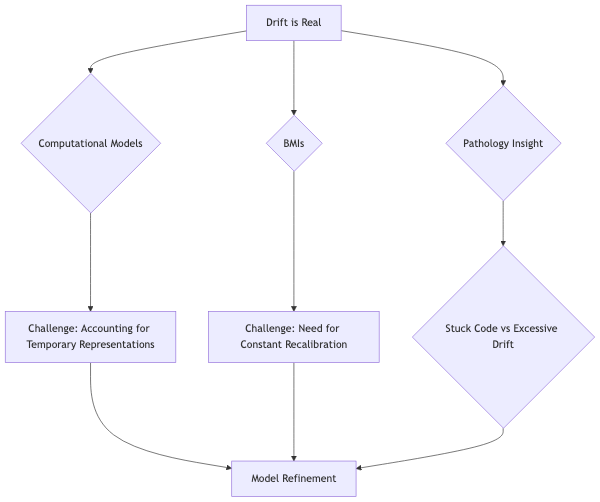
Consequences of Malleable Neural Maps. Shows how the understanding of drift impacts computational models, BCI technology, and understanding neurological pathology.
These research threads—the noise, the optimization, and the homeostasis—are currently being illuminated by researchers like Andrew Fink of Northwestern University, who notes that this field is “so full of possibilities” because it raises “really deep questions about what’s going on in the brain.” Christopher Harvey of Harvard Medical School emphasizes that this phenomenon might simply be an umbrella term, under which dozens of distinct underlying mechanisms will eventually be revealed.
In sum, the realization that the brain code is in constant flux is not the end of the story; it is the glorious, baffling beginning of a new chapter in understanding the dynamic miracle of consciousness. It suggests that our minds are not rigid libraries storing fixed facts, but vibrant, ever-rearranging ecosystems adapting in real-time to the torrent of existence.
** This article synthesizes findings reported in the Nature News feature, “The Brain Code Seems to Be in Constant Flux: Neuroscientists Are Baffled,” by Diana Kwon (2026).*
This blog post is based on this research article.
If you liked this blog post, I recommend having a look at our free deep learning resources or my YouTube Channel.
Text and images of this article are licensed under Creative Commons License 4.0 Attribution. Feel free to reuse and share any part of this work. AI was used to support the creation of this article.