
Squeezing Intelligence into Tiny Files: How AI is Rethinking Data Compression


For decades, the art of data compression—the magic that shrinks massive files into manageable packets—has relied on mathematical algorithms perfected over generations. Think of the tools that make sharing photos, downloading movies, or sending emails possible. These systems are robust and reliable. However, the colossal surge in the amount of digital information we generate daily demands smarter, more powerful ways to shrink that data. Enter Large Language Models (LLMs), the incredibly sophisticated engines behind chatbots and advanced AI reasoning. Intriguingly, these models are not just brilliant at generating human-like text; they possess a deep, almost fundamental connection to the very act of compression.
The Theoretical Bridge Between Language and Logic
The idea that language modeling and data compression are inherently linked is not new; it’s a sophisticated theoretical concept. At its heart, language modeling involves training a machine to predict the next word in a sequence based on the words that came before it. When an LLM becomes exceptionally good at predicting text, it means it has learned the underlying patterns, redundancies, and probability distributions of that text incredibly well. In essence, if a model can predict something with high confidence, it means that information is highly predictable, and therefore, highly compressible. The information you need to reconstruct the original text is minimal—it’s just the statistical knowledge held within the model.
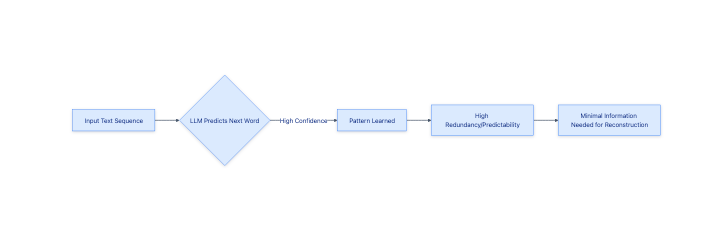
How LLMs Achieve Compression. High prediction confidence implies low randomness, meaning the information is redundant and highly compressible.
However, this powerful theory has remained mostly confined to academic curiosity. While prior attempts have shown that LLMs can outperform traditional compressors in terms of how small a file they can make, they suffer from a crippling flaw: sheer computational cost. Early systems, such as LLMZip, demonstrated stunning compression ratios, but the price of that intelligence was prohibitive. To compress a modest 10 megabytes of text, these systems were reported to require an astronomical 9.5 days of continuous computation. This made them fascinating proofs-of-concept but entirely impractical for any real-world deployment.
FineZip: Giving LLMs a Practical Push
The research presented in the 2024 arXiv paper, “FineZip: Pushing the Limits of Large Language Models for Practical Lossless Text Compression,” addresses this monumental gap between theoretical potential and practical usability. The researchers sought to transform a computational curiosity into something plausibly usable. They did this by tackling the two primary bottlenecks that made prior LLM compression systems unusable: the massive time requirement of inference, and the limitation imposed by fixed computational windows.
FineZip is a clever marriage of two distinct, high-level techniques: online memorization and dynamic context.
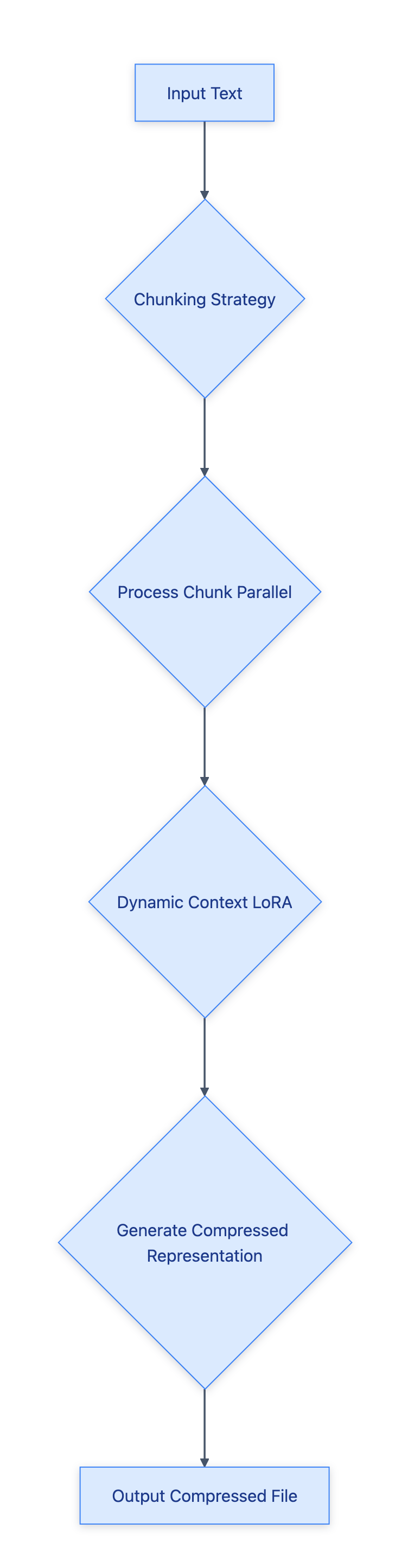
FineZip’s Processing Workflow. FineZip enhances LLMs by adding specialized memory (LoRA) and processing data in parallel chunks to overcome sequential bottlenecks.
To explain these concepts for a lay audience, consider a massive textbook. A traditional LLM is like a brilliant student who read the entire textbook once, but has no memory of any single page while taking a test. When compressing a new book, it relies only on its general knowledge. FineZip introduces online memorization, which allows the model to briefly adapt itself to the specific text it is currently compressing. This adaptation is achieved through a technique called parameter-efficient fine-tuning (PEFT), specifically utilizing LoRA. Think of LoRA not as retraining the entire enormous brain of the LLM, but as adding a tiny, highly specialized notepad that the model uses only for the current document. This notepad quickly learns the nuances and specific statistical quirks of the data being compressed, sharpening its predictive accuracy for that corpus. Critically, this process is designed to require only a negligible amount of extra storage, so the model doesn’t have to carry the entire compressed file within its memory structure.
The second innovation, dynamic context, directly assaults the parallelism issue. In older, rigid LLM compression methods, the model had to process text sequentially—one token at a time—because predicting any single word required knowing the fixed block of words (the context window) immediately preceding it. This auto-regressive nature forced a slow, step-by-step crawl. FineZip circumvents this by employing a two-step chunking strategy. Instead of forcing every token to see the full historical context, the system divides the text into manageable chunks. Within each chunk, the model is given a context size that is dynamic. This allows the system to process different parts of the data simultaneously (batching), transforming a serial, painfully slow process into a highly parallelizable one, which is the key to achieving massive speed gains.
The Impressive Results of the Engineering Breakthrough
The results showcased in the paper speak volumes about the success of combining these ideas. The researchers rigorously compared FineZip against several competitors, including classic algorithms like zlib and gzip, and advanced neural network compression techniques.
When compared to the prior state-of-the-art, LLMZip, which utilized the Llama-3 8B model, the improvements were staggering. Where LLMZip required nearly ten days to process just 10 MB of data, FineZip slashed that time down to approximately four hours. This represents a phenomenal 54-fold speedup in wall-clock time, while maintaining compression ratios that are highly comparable to the baseline system. Furthermore, when benchmarked against traditional algorithms, FineZip demonstrated a significant lift in compression effectiveness, improving compression ratios by roughly 50% over classical methods.
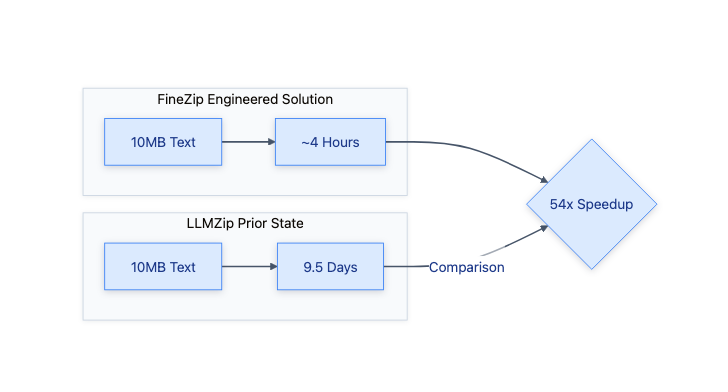
Performance Improvement: LLMZip vs FineZip. FineZip dramatically reduced the processing time by 54-fold compared to prior LLM methods while maintaining strong compression.
The study didn’t stop there. The researchers also explored the role of hardware efficiency through quantization. By implementing the memorization step using 4-bit quantized versions of the model, they were able to achieve an additional 4-fold speedup in compression time, making the system even faster and showcasing how hardware optimizations can unlock more of the LLM’s raw potential.
A Groundbreaking Endeavor by a Collaborative Team
This complex feat of engineering—melding advanced machine learning theory with the hard realities of computational speed—was achieved by a group of researchers who tackled the problem from multiple angles. The work is credited to Fazal Mittu, Yihuan Bu, Akshat Gupta, Ashok Devireddy, Alp Eren Ozdarendeli, Anant Singh, and Gopala Anumanchipalli. The core research effort was conducted by members affiliated with institutions including UC Berkeley and NYU.
Looking Ahead: The Future of Digital Efficiency
While the paper is careful to note that FineZip is not yet a product ready for massive, everyday deployment—four hours for ten megabytes is still a research-scale achievement—it represents a vital turning point. This study validates that the theoretical promise of LLMs in compression can, with careful engineering, begin to meet the demands of practicality.
The implication for the field is profound. It pushes the boundary of what we consider “feasible” with neural networks for data utility. If systems like FineZip can demonstrate a viable path to balancing superior compression ratios (a hallmark of modern AI) with acceptable processing speeds, it opens the door for an entirely new era of data management. Imagine scenarios where highly complex data sets, like vast genomic sequences or intricate scientific simulations, could be compressed with unparalleled accuracy, making them faster to store, transmit, and analyze. While significant work remains—the researchers themselves emphasize this—FineZip serves as a powerful demonstration that the fusion of sophisticated language understanding and efficient computational tactics can truly move us closer to unlocking the full, economical potential of artificial intelligence.
This blog post is based on this research article.
If you liked this blog post, I recommend having a look at our free deep learning resources or my YouTube Channel.
Text and images of this article are licensed under Creative Commons License 4.0 Attribution. Feel free to reuse and share any part of this work. AI was used to support the creation of this article.