
Seeing Everything in One Glance: Unlocking Universal Vision with the Reconstruct Anything Model
The Mystery of Imperfect Pictures and the Dawn of Universal Imaging

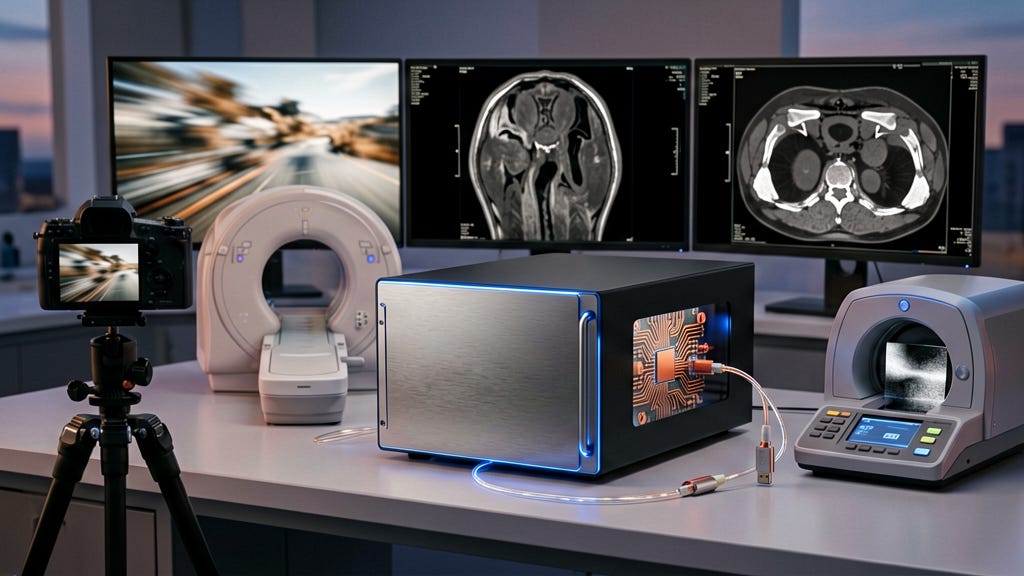
Imagine trying to recover a perfect photograph from a blurred snapshot taken in low light, or trying to reconstruct the precise internal structure of the human body from sparse, noisy data collected by an MRI machine. These are not simple digital cleanups; they are profound challenges that sit at the heart of computational imaging. At its core, this field grapples with what mathematicians call “inverse problems.”
For a layperson, the concept of an inverse problem is beautifully simple yet deeply difficult. In imaging, the process usually works like this: you have a pristine, original image, and some process—like blurring from camera shake, taking an X-ray with limited angles, or only measuring specific points on a scan—transforms it into a corrupted measurement. This transformation is governed by a precise, known mathematical recipe, often called the “forward operator” (A). The inverse problem is the Herculean task: given the corrupted measurement (y) and the mathematical rule (A), how do you intelligently reverse the process to recover the original image (x)?
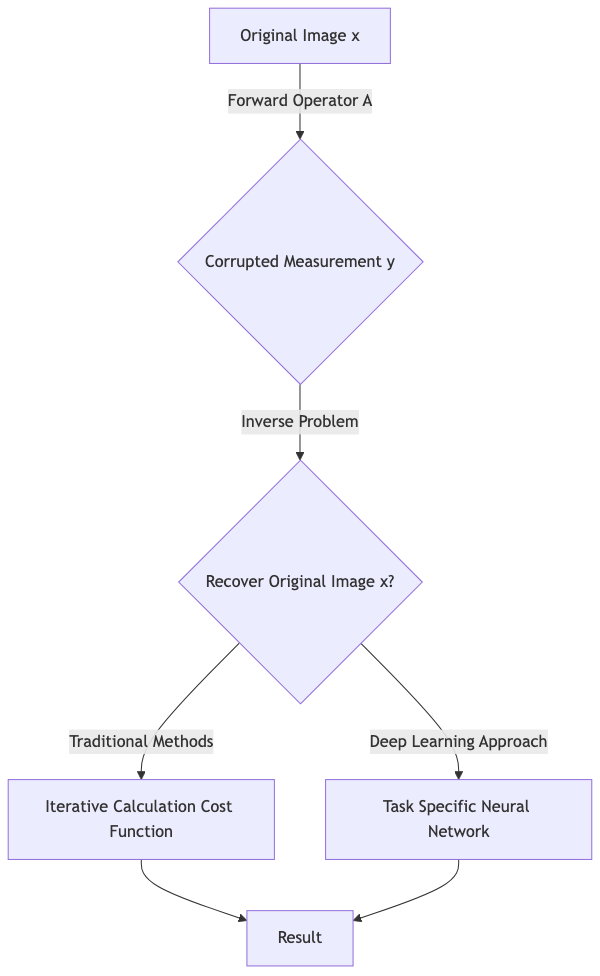
The Mystery of Imperfect Pictures and the Dawn of Universal Imaging. Traditional imaging challenges are framed as inverse problems: starting with a corrupted measurement and needing to mathematically recover the original, pristine image.
Traditionally, solving this has required painstaking, step-by-step, iterative calculations. These classic methods try to minimize a cost function that balances two things: how closely the result matches the actual measurement (data fidelity) and how ‘sensible’ the result looks, guided by prior knowledge of what images should look like (a “prior,” such as smoothness).
The recent boom in deep learning has introduced two main approaches to this problem. First, one can build a neural network designed specifically for one job—say, only deblurring—and train it exhaustively on millions of deblurring examples. This is fast once trained, but it cannot jump to solve MRI reconstruction tomorrow. Second, researchers have started “unrolling” these iterative algorithms, effectively baking the math into the network’s structure. While this allows flexibility, the resulting models are often massive, computationally expensive, and require a full, custom training cycle for every new type of imaging task.
A Paradigm Shift in Image Recovery: Meet the RAM Model
In 2025, researchers have introduced a framework that appears to knit these disparate approaches into a singular, elegant solution. This breakthrough, presented in the paper “Reconstruct Anything Model: a Lightweight General Model for Computational Imaging” (arXiv preprint 2503.08915), is poised to change how we approach imaging science. It introduces the Reconstruct Anything Model (RAM), a fundamentally different way of thinking about imaging reconstruction.
If previous models specialized to a single lens, RAM is designed to be a universal toolkit. What makes RAM so inspiring is its ability to perform reconstruction in a non-iterative, single forward pass. This means instead of running a slow loop of calculations, you feed the corrupted data and let the model spit out the answer instantly.
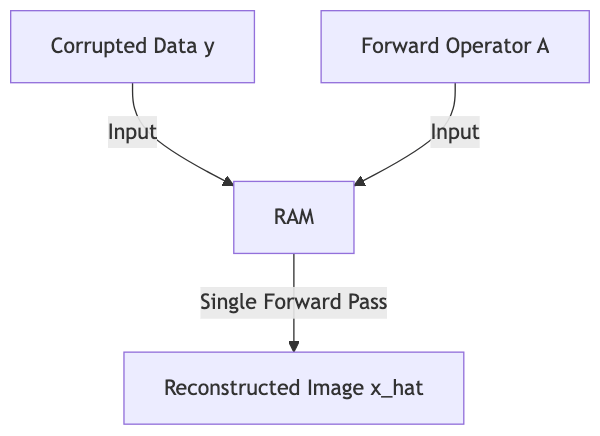
A Paradigm Shift in Image Recovery: Meet the RAM Model. The RAM model achieves reconstruction in a single forward pass by integrating both the corrupted data and the known physics (the forward operator A) directly into its input.
Crucially, RAM achieves this by accepting two very important pieces of knowledge as direct inputs: the corrupted measurement and the exact mathematical description of how that corruption occurred (the forward operator, A). This integration of physics and intelligence is the key innovation. Instead of being trained only on pictures, RAM is trained to understand the rules of the game itself.
How RAM Unites the World of Imaging
To understand this leap forward, we must look at how RAM is engineered. The model is built upon an existing, successful convolutional neural network backbone, originally known as DRUNet. The genius lies in the modifications layered onto this foundation.
The process begins with a proximal estimation module. This acts as a sophisticated translator, taking the raw, corrupted measurement and preparing it for the network, akin to mapping the corrupted data into a format that the core processing layers can best understand.
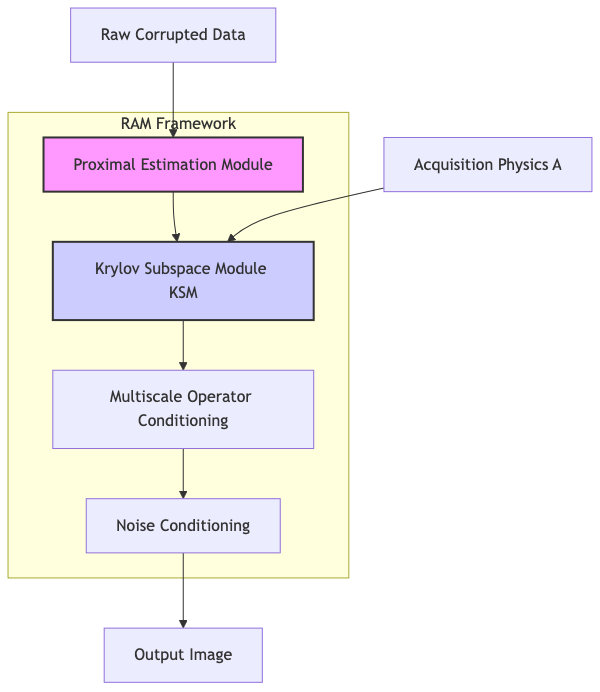
How RAM Unites the World of Imaging. RAM generalizes imaging reconstruction by layering specialized modules—like the Proximal Estimation Module and KSM—onto a base network to adapt to different physics.
The heart of the generalization is the Krylov Subspace Module (KSM). In traditional iterative solvers, the Krylov subspace methods are the computational engines that drive convergence. Instead of executing these calculations iteratively, RAM teaches the network how to mimic them. The KSM allows the model to efficiently condition its internal feature maps on the acquisition physics (A) through learned linear combinations of operations involving A and its transpose (A^top). This allows the network to adapt to different physical processes—be it the spreading of light in a blur or the spatial frequency sampling in MRI—without needing a complete overhaul.
Furthermore, the design is cleverly augmented with multiscale operator conditioning. Recognizing that the difficulty of an imaging problem changes depending on the resolution scale—a concept borrowed from multigrid methods—RAM doesn’t just look at the finest details. It processes the forward operators across multiple coarse grids, ensuring robust performance regardless of the fine-scale instability that plague many reconstruction techniques.
To ensure it can handle the messy reality of experiments, RAM also incorporates sophisticated noise conditioning. It doesn’t just assume noise; it explicitly takes the noise parameters—whether they come from a simple Gaussian distribution or a more complex Poisson-Gaussian model—as input. This gives the model remarkable robustness.
A Small Team, Monumental Reach
This sophisticated engineering feat was the result of a focused collaboration involving experts in advanced computation and image processing. The work was led by Matthieu Terris, and contributed by Samuel Hurault, Maxime Song, and Julian Tachella. Their affiliations span leading research institutions in France, including the CEA (Commissariat à l’énergie atomique et aux énergies alternatives), ENS de Lyon, and CNRS.
Why This Matters: From Lab Experiment to Clinical Reality
The practical implications of RAM are vast. Currently, putting a novel reconstruction technique into a hospital or a cutting-edge lab is a monumental undertaking. It requires building, training, and validating a bespoke neural network model for every new scanner, every new drug imaging modality, or every slightly different noise profile.
RAM changes this deployment story. Because it is a single, lightweight architecture—with only around 36 million parameters—it can be trained once across a zoo of problems: deblurring, MRI, CT, inpainting, and super-resolution. More powerfully, it can be adapted to an unseen, specific instrument in a hospital by undergoing only a tiny bit of few-shot fine-tuning using measurements from just a handful of actual images—sometimes even just one! This process can be performed in minutes on consumer-grade hardware, an efficiency staggering compared to the immense computational cost of older methods.
The model showcases remarkable flexibility. It performs superbly on tasks it was trained on, but its true power is revealed in its zero-shot performance on problems it has never seen—such as applying a model trained on Gaussian-noise CT scans to solve a CT problem corrupted by Poisson noise. Moreover, it can be cleverly extended to solve non-linear challenges like blind deblurring or phase retrieval by integrating it into existing iterative frameworks.
This research firmly suggests that many seemingly disparate imaging tasks—whether it’s diagnosing a lung nodule via CT or analyzing ultra-low-light biological samples via cryo-EM—might share a deep, unifying mathematical structure. RAM doesn’t just solve one problem well; it suggests a unified language for all of them.
If the field can capitalize on this foundational model, the barrier to entry for deploying advanced, AI-powered diagnostic and scientific tools will plummet, ushering in an era where powerful imaging reconstruction is no longer a custom-built, bespoke project, but a readily available, adaptable piece of scientific infrastructure.
This blog post is based on this research article.
If you liked this blog post, I recommend having a look at our free deep learning resources or my YouTube Channel.
Text and images of this article are licensed under Creative Commons License 4.0 Attribution. Feel free to reuse and share any part of this work. AI was used to support the creation of this article.