
Peering Inside the Engine: Diving into the Design Space of Modern AI Agents


The landscape of Artificial Intelligence is undergoing a profound shift, moving beyond simple suggestion toward genuine, autonomous action. Tools are no longer just sophisticated autocomplete functions; they are evolving into digital colleagues—AI agents capable of planning, executing code, navigating file systems, and interacting with the digital world on our behalf. This transformation from passive assistant to active doer raises fundamental engineering questions: How do we build these systems safely? How do we manage their memory? And crucially, where should the core reasoning live versus where the operational enforcement resides?
To chart this uncharted territory, researchers have turned to the source code of leading production systems. A fascinating deep dive, presented in the 2026 tech report Dive into Claude Code: The Design Space of Today’s and Future AI Agent Systems by Jiacheng Liu, Xiaohan Zhao, Xinyi Shang, and Zhiqiang Shen, offers one of the most detailed architectural blueprints we have seen. This analysis treats the sophisticated TypeScript source code of Claude Code—Anthropic’s powerful agentic coding tool—as a living Rosetta Stone, allowing the team to reverse-engineer the underlying philosophy driving its complex mechanisms. It is a study that serves as a masterclass in understanding the engineering trade-offs required to make AI systems reliable in the messy reality of software development.
Uncovering the DNA: The Values Driving Agent Design
The authors, Liu, Zhao, Shang, and Shen, do not start by detailing code; they begin by articulating why the code looks the way it does. They posit that every production agent must be motivated by a set of human values. They distilled these down to five core tenets: Human Decision Authority, Safety and Security, Reliable Execution, Capability Amplification, and Contextual Adaptability. These are not mere buzzwords; they are the philosophical anchors that shape every subsequent architectural choice.
For instance, the tension between giving the AI maximum freedom (Capability Amplification) and ensuring the human remains in charge (Human Decision Authority) is managed by a system built on layers of judgment. Safety, for example, is not bolted on as an afterthought; it is woven into the fabric, motivating principles like “Defense in Depth with layered mechanisms.” This means the system doesn’t rely on a single security guard; it employs multiple, overlapping lines of defense to protect code and data, even if the human user is momentarily distracted.
The Quiet Workhorse: Anatomy of the Agent Loop
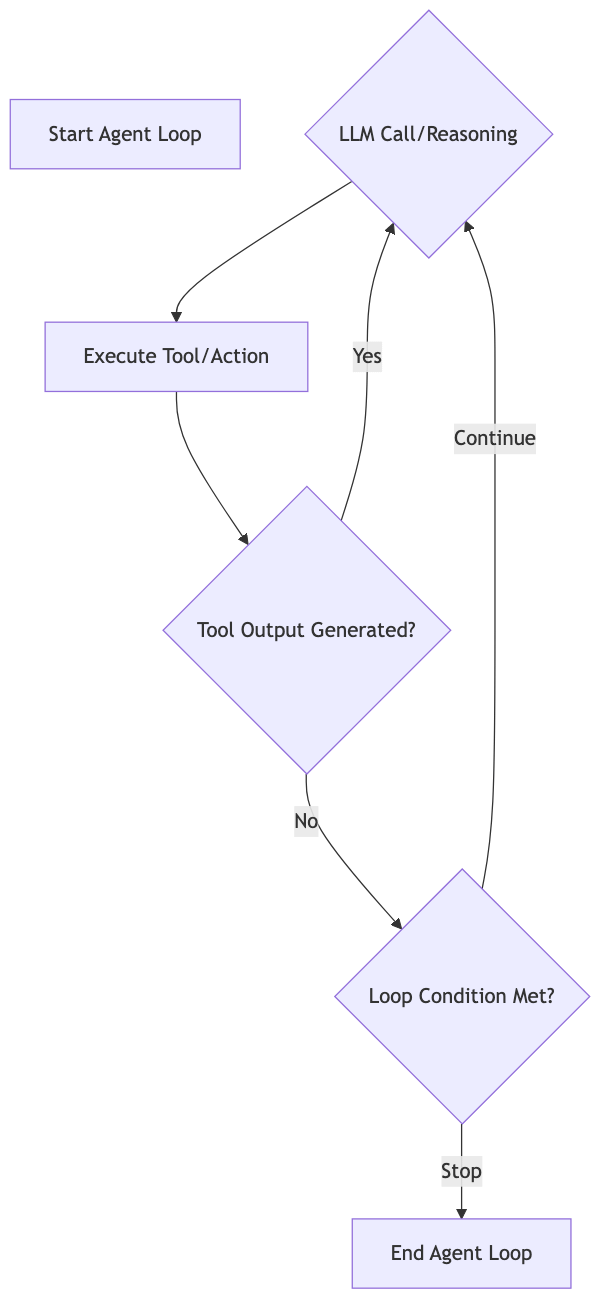
While the concept of an AI agent often conjures images of complex, graph-based planners making monumental decisions, the authors reveal a powerful counterpoint. The true engine of Claude Code, at its simplest level, is a remarkably straightforward `while-loop` that calls the language model, executes the resulting tools, and repeats. The sheer weight of the system—the complexity that elevates it from a simple loop to a robust production tool—lies in everything around that coreiteration
.
Anatomy of the Agent Loop. Despite its complexity, the core of the agent loop is a simple iteration cycle, where infrastructure handles most of the heavy lifting.
The code is dominated by infrastructure. Nearly 98.4% of the codebase is dedicated to operational scaffolding, while less than 1.6% constitutes the actual AI decision logic. This finding is pivotal: it demonstrates a design philosophy that invests heavily in deterministic infrastructure—the guardrails, the routing, the recovery logic—to enable, rather than dictate, the model’s reasoning.
Controlling the Flow: Seven Layers of Security
When the AI decides it needs to perform an action—say, running a command in the terminal—that request does not sail through unchecked. It tumbles through a rigorous permission pipeline involving seven distinct, independent layers. This security architecture is a prime example of the “Defense in Depth” principle. These layers include initial blanket-denied tool filtering, a core “deny-first” rule engine (meaning a denial always trumps an allowance), seven specific permission modes ranging from complete control to high automation, an integrated Machine Learning classifier for automated risk assessment, the physical restriction of shell sandboxing, and crucially, a design choice to not restore session-scoped permissions when a user resumes a session. This latter point is a conscious decision to err on the side of caution, treating each new session as a clean slate of trust.

Seven Layers of Security. The agent’s request to perform an action passes through a rigorous, multi-layered pipeline for defense in depth.
Sculpting Memory: The Five-Tier Context Compressor
Perhaps the most fascinating aspect for anyone interested in scaling AI is how the system handles the context window—the finite memory of the model. Since modern AI models have finite attention limits, the system must constantly decide what to forget and what to keep. Claude Code employs a remarkably sophisticated, five-layer context compaction pipeline, which runs before every single model call. This is a graduated degradation strategy: instead of simply chopping off the oldest conversation parts, the system tries increasingly aggressive methods. First, it enforces strict size limits on tool outputs. Next, a lightweight trim removes older segments. If context pressure remains, finer-grained compression kicks in, followed by a “context collapse”—a read-time projection that lets the model see a summary of history without actually modifying the original logs. Finally, as a last resort, the system asks the model itself to generate a comprehensive summary. This layered approach reflects a profound engineering trade-off: it sacrifices simplicity for resilience against context overflow.
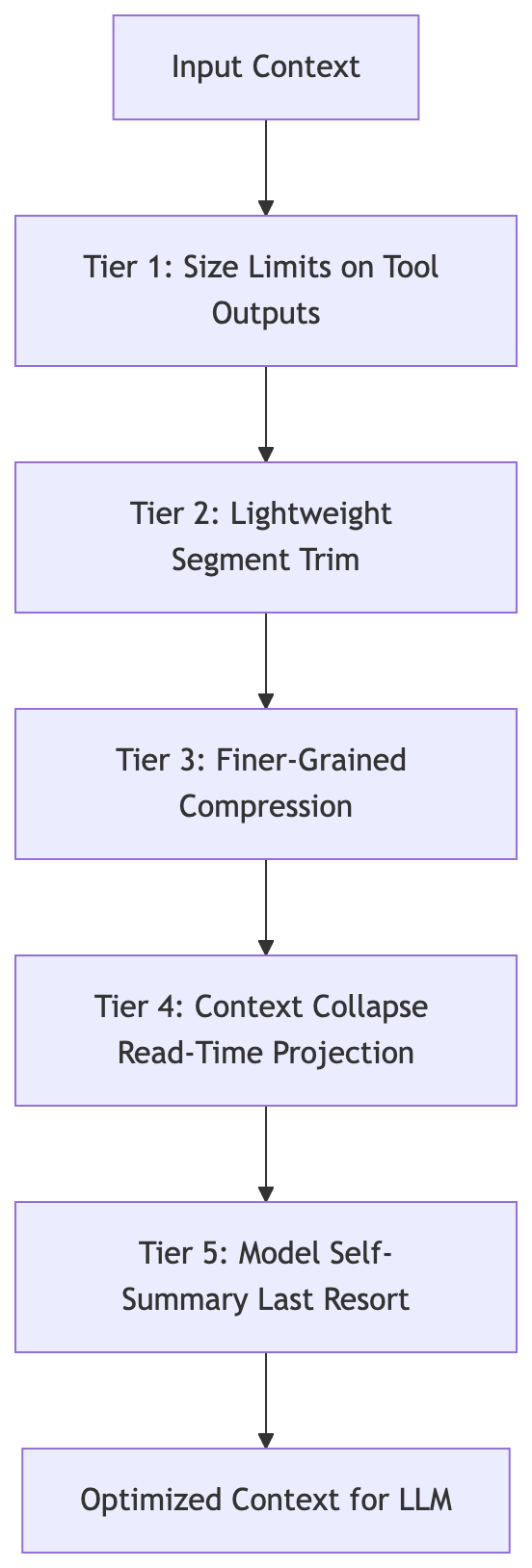
Five-Tier Context Compressor. The system uses a layered, graduated degradation strategy to manage the model’s finite context window before every call.
A Tale of Two Systems: Comparing Claude Code to OpenClaw
To provide a richer perspective, the authors compared Claude Code to OpenClaw, an independent, open-source AI agent system designed not for coding, but as a persistent, multi-channel personal assistant gateway. This comparison reveals that the questions faced by AI builders are universal, but the answers are dictated by the deployment environment.
Where Claude Code is an ephemeral, single-repository coding harness, OpenClaw is a sprawling, persistent daemon controlling connections across WhatsApp, Slack, and Discord. This difference fundamentally reshaped their solutions. For instance, Claude Code relies on per-action safety checks because it assumes an untrusted model running on a developer’s machine, placing its trust boundary between the model and the execution environment. Conversely, OpenClaw centers its security around the gateway’s perimeter, relying on identity and access control for its single trusted operator. Furthermore, Claude Code organizes its extensions (like custom tools or plugins) by how much context they cost—hooks are zero-cost, skills are low-cost, and server integrations are high-cost. OpenClaw, however, structures its plugins around a central capability registry that extends the gateway’s surface to all connected agents.
Building Blocks of Extension: Why Four Mechanisms?
The system’s ability to adapt comes from its extensibility—how easily developers can inject new functionality. Claude Code opts for four distinct mechanisms: Model Context Protocol (MCP) servers, plugins, skills, and hooks. One might ask why not consolidate this into a single API. The answer, as detailed in the report, lies in the concept of context cost. Each mechanism imposes a different burden on the agent’s finite memory. Hooks are zero-cost lifecycle interceptors; skills inject domain instructions with minimal context impact; plugins offer a flexible, multi-component distribution format; and MCP servers inject complex, external tool definitions that can be quite memory-heavy. This graduated approach ensures that simple, lightweight enhancements don’t overwhelm the model’s attention span.
The Open Frontier: What Comes Next?
This comprehensive architectural analysis does not provide final answers; rather, it spotlights critical open questions for the next generation of AI. The authors identify six major directions. Paramount among these is the growing tension between short-term productivity and long-term human capability. Empirical studies suggest that while AI can speed up coding, over-reliance may atrophy a developer’s underlying skills or increase overall code complexity. Claude Code’s architecture, while capable of massive short-term amplification, offers limited explicit mechanisms to preserve long-term human understanding.
Future research must confront questions regarding how to achieve horizon scaling—how to maintain coherence across projects spanning months—and how to integrate external regulatory pressures, such as those emerging from the EU AI Act, into the core design.
The architectural deep-dive presented by Liu, Zhao, Shang, and Shen provides more than just a map of existing technology; it provides a vocabulary for discussing the future of AI agency. By meticulously dissecting a production system, they offer the agent-building community a set of recurring design questions and trade-off landscapes, guiding us toward building systems that are not just smarter, but demonstrably more reliable and human-centric.
This blog post is based on this research article.
If you liked this blog post, I recommend having a look at our free deep learning resources or my YouTube Channel.
Text and images of this article are licensed under Creative Commons License 4.0 Attribution. Feel free to reuse and share any part of this work. AI was used to support the creation of this article.