
Mind Over Matter? Why the "Hard Problem" of Consciousness Might Be a Misunderstanding

For decades, the question of consciousness has captivated and confounded thinkers across philosophy, neuroscience, and physics. At the heart of this enduring enigma lies what is known as the “Hard Problem of Consciousness”—the seemingly insurmountable hurdle of explaining why and how physical brain processes give rise to subjective experience. Why does the firing of neurons feel like the specific redness of a sunset, or the pang of melancholy? This gap between objective, measurable brain activity and private, felt experience has led many to postulate a fundamental division between mind and matter, a dualistic split that shapes much of modern philosophical debate.
Yet, a fresh and compelling argument has surfaced from the realm of theoretical physics. In a recent essay published in Noema Magazine in May 2026, physicist Carlo Rovelli lays out a powerful case against this perceived division. Rovelli does not attempt to solve the enigma of consciousness in the way a machine learning model might simulate it. Instead, he challenges the very structure of the question, suggesting that the “Hard Problem” itself is a conceptual misunderstanding, a product of persistent human resistance to a unified view of reality.
A New Lens on Ancient Fears
Rovelli’s perspective is not merely an academic adjustment; it is framed as a necessary correction to a long-running pattern of human intellectual fear. He draws a striking historical parallel, noting that the current fascination with the consciousness gap echoes other moments in human history where new scientific understanding clashed violently with cherished traditional views. He points to the resistance during the Renaissance when many found it hard to accept that the heavens and the Earth were fundamentally of the same nature, or the uproar following Darwin’s revelation that humans shared a distant ancestry with all other life. These historical moments, Rovelli argues, were not failures of science, but moments where ingrained cultural ideas—like the notion of a transcendent soul separate from material reality—were shaken.
Rovelli maintains that this pattern continues in contemporary debates. The idea that consciousness possesses a mysterious, irreducible gap when contrasted with physical processes mirrors earlier divides: the split between heaven and earth, the division between human and animal, and the split between living and inanimate matter. For Rovelli, the apparent metaphysical chasm that Chalmers identified—the gulf between brain mechanics and felt experience—is simply the latest iteration of this cultural impulse to carve reality into distinct, stubbornly separate domains.
Redefining the Explanatory Gap
The crux of the traditional challenge lies in the concept of the “explanatory gap.” Proponents of the hard problem argue that even if we mapped every single neural firing associated with seeing the color red, we still wouldn’t explain why that process results in the specific, subjective experience we call “red.” Rovelli attacks this idea head-on, labeling the claim of this gap as conceptually incoherent.
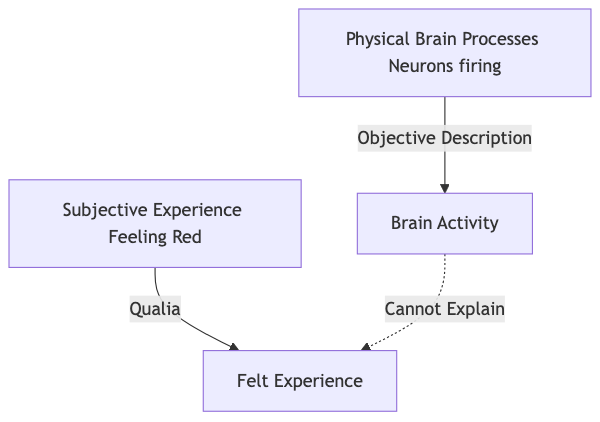
The Conventional View of the Explanatory Gap. This diagram illustrates the traditional divide where objective brain states are seen as insufficient to explain subjective experience.
He asks a critical question of the reader: How can we possibly know what we would understand if we were to grasp something we currently do not understand? He contends that this question implies an impossible leap of intuition—a notion that is logically problematic. Furthermore, Rovelli critiques the tendency to view science as an external, objective vantage point completely divorced from human experience. In his view, science is not some external observer peering into a private theater; rather, science is the historical, successful organization of human experience itself. To treat scientific knowledge as coming from a “view from nowhere” is, in itself, to presuppose the very dualism it claims to resolve.
The Subjective Viewpoint as a Perspective, Not a Barrier
The most profound shift in Rovelli’s argument involves reframing subjectivity. When we talk about “qualia”—the phenomenal properties of experience—such as the feeling of redness, Rovelli proposes a pragmatic definition: “‘red’ is the name of the process we generally undergo when we see or remember or think about the color red.” He asserts that we do not need to offer a mystical explanation for why the process feels red, just as we do not need to explain why an entity we categorize as a “cat” looks like a cat.
This framework dissolves the philosophical concept of the “hard problem” by treating the first-person experience and the third-person scientific description of the same event as mere perspectives on a single underlying phenomenon. Subjectivity, therefore, is not a mystical add-on; it is just a particular way of looking at reality—a specific perspective.
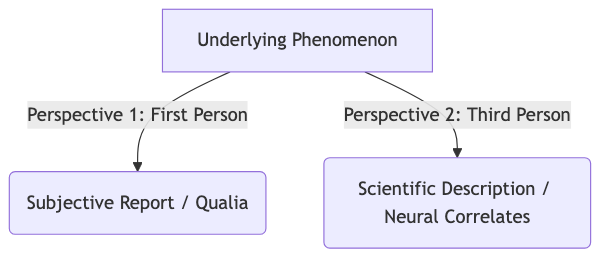
Rovelli’s Reframing: Subjectivity as Perspective. Rovelli argues that subjective experience and third-person science are different ways of describing the same underlying phenomenon.
Rovelli reinforces this with an attack on the thought experiment of the “philosophical zombie.” This hypothetical being is physically and behaviorally identical to a human but lacks inner experience. Critics often use the zombie to prove that consciousness must be non-physical. Rovelli counters that this argument is self-defeating. If the zombie functions identically, it would report its states exactly as we do. The only reason to distinguish the zombie is to presuppose—before the argument even begins—that there is some hidden, non-physical element at work, precisely what Chalmers seeks to prove.
A Convergence of Thought: Physics Meets Computation
It is important to note that Rovelli’s rigorous philosophical positioning does not arrive in a vacuum. His argument converges with contemporary research emerging from computational neuroscience, even if their entry points are different. For instance, earlier work by Krauss and Maier (in Frontiers in Computational Neuroscience, 2020) explored consciousness from a highly functionalist, mechanistic perspective, examining theories like Integrated Information Theory (IIT) and Global Workspace Theory (GWT). They sought to show that consciousness could be operationalized and implemented in computer programs.
While Krauss & Maier operated within a framework committed to mechanistic explanations, Rovelli provides a powerful philosophical foundation for their operational stance. Where computational scientists propose that mind is a “high-level language” description of physical brain processes, Rovelli grounds this in the historical track record of physics itself. He builds upon the convergent idea that consciousness is “hard” only in the sense that it is a very complicated natural phenomenon, much like predicting a complex thunderstorm.
Rovelli’s key innovation, however, lies in his unique framing. His historical pattern argument, his assertion that the “explanatory gap” is incoherent, and his sharp dismantling of the zombie argument are distinct contributions. His overall thrust is that monism—the idea that everything is of the same basic nature—is not a hopeful scientific aspiration but a pattern already confirmed by centuries of scientific discovery closing perceived metaphysical gaps.
Embracing the Unified Nature of Reality
The conclusion Rovelli draws is profoundly optimistic for a scientifically informed worldview. He insists that to reject dualism upfront is to embrace a picture far more faithful to the evidence of nature than any dualistic model. We can speak of our emotions, our inner lives, and our spiritual experiences without resorting to the language of the miraculous or the transcendent. Mental processes are not added to the physical state; they are derived from a complete physical account, described through the salient characteristics that make sense to us.
This intellectual move suggests that the ultimate challenge for science and philosophy is not to bridge an unbridgeable gap, but simply to look closely enough at the interconnectedness of the universe. We are not observers separate from the cosmic ballet; we are participants woven into its very fabric.
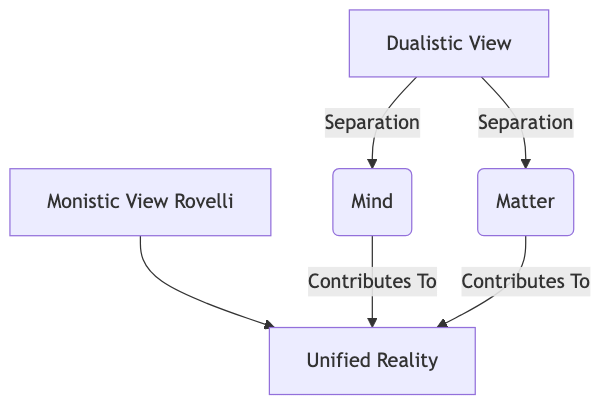
From Dualism to Monism: The Unified View. This workflow shows the shift from viewing mind and matter as separate entities to understanding them as parts of one reality.
In sum, Carlo Rovelli, the theoretical physicist known for his deep dives into quantum gravity, offers a powerful, accessible reframing of one of science’s deepest puzzles. By arguing that the “Hard Problem” is a lingering shadow of historical dualism, he invites us to exchange existential dread for intellectual curiosity, urging us to embrace the view that our inner world is wonderfully, necessarily, part of the material reality.
This blog post is based on this research article.
If you liked this blog post, I recommend having a look at our free deep learning resources or my YouTube Channel.
Text and images of this article are licensed under Creative Commons License 4.0 Attribution. Feel free to reuse and share any part of this work. AI was used to support the creation of this article.